
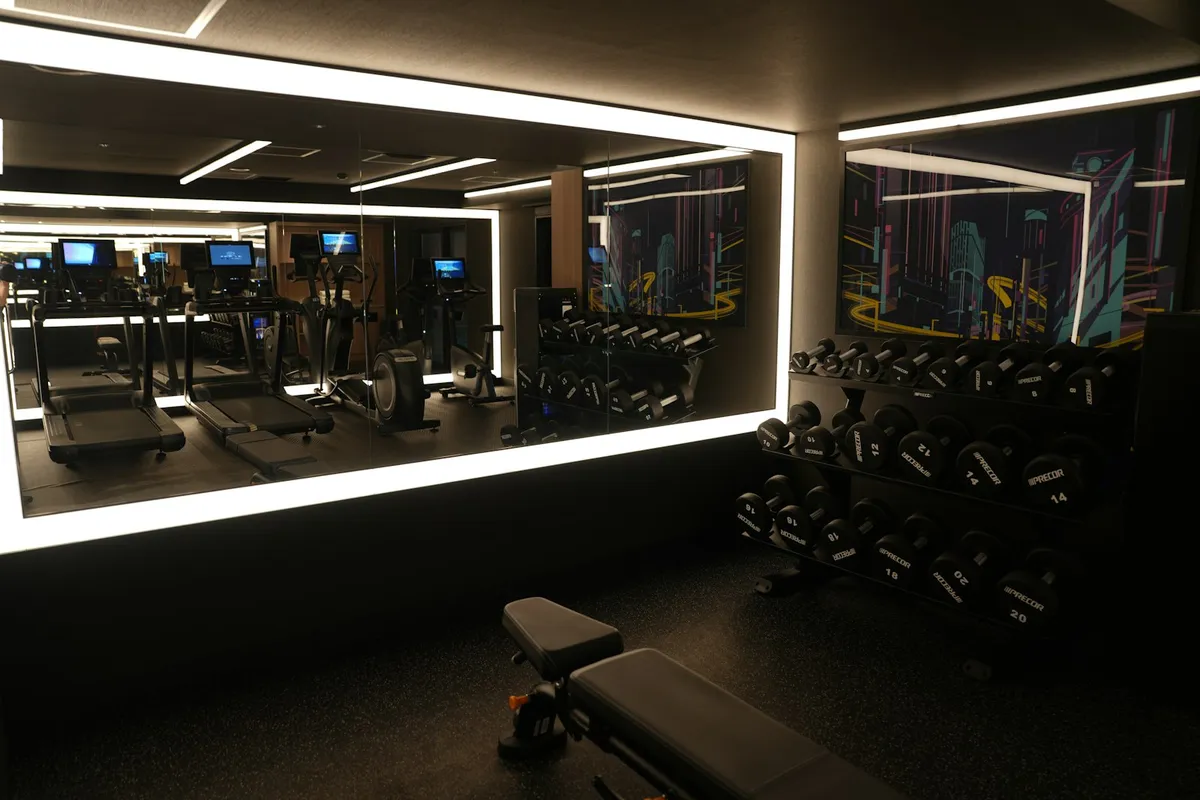
The Hotel Gym Audit: A 15-Minute Full-Body Session With Nothing But a Treadmill and One Dumbbell Rack
You've been there. You walk into the hotel gym at 6 a.m. expecting a cardio room and a shelf of light dumbbells, and that's exactly what you get: two treadmills, a mirror, and a rack that tops out around 40-50 lbs. The easy move is to call it "not a real gym" and skip the session. That's the wrong read. A treadmill and one dumbbell rack is enough equipment to run a full-body session that actually moves the needle — if you walk in with a plan instead of hoping something comes to you on the spot.
This is the exact audit we hand clients before a trip: fifteen minutes, two pieces of equipment, zero wasted motion.
What You're Actually Working With
Almost every hotel gym, from a Marriott in a business park to a boutique property downtown, has the same two assets: a cardio deck (treadmill, maybe a bike) and a compact dumbbell rack running somewhere between 5 and 50 lbs. That's not a limitation — it's a constraint, and constraints are what make a session efficient. You don't need twelve machines to train your whole body. You need one loaded hinge, one loaded push, one loaded pull, and something that raises your heart rate. A treadmill and a dumbbell rack cover all four.
The 15-Minute Audit Protocol
Pick the heaviest pair of dumbbells you can control for 10-12 clean reps — on most hotel racks, that's going to land in the 25-35 lb range per hand. Run this as a circuit, minimal rest between movements, 60-90 seconds between rounds:
- Minute 0-3: Incline walk ramp. Treadmill at a 10-12% incline, pace fast enough that talking is hard. This is your warm-up and your first cardio hit in one move — no separate "warming up" phase that eats into your fifteen minutes.
- Minute 3-11: Three-round dumbbell circuit. Goblet squat x12, single-arm row x10 per side, dumbbell floor press x12, reverse lunge x10 per side. That's one hinge, one pull, one push, one unilateral leg pattern — the four movements that cover 90% of what your body needs in a week.
- Minute 11-15: Finisher. Back to the treadmill, 1-minute hard incline walk, 1-minute easy, repeat twice. This is where the session earns its cardio credit without adding a separate 30-minute run you don't have time for.
Fifteen minutes, full body, elevated heart rate, done before the buffet opens.
Why Minimum Effective Dose Wins on the Road
This isn't a watered-down workout because you're traveling. It's the same principle we train on at home: the minimum effective dose that produces a real training effect, not the maximum amount of time you can stand in a gym. A loaded squat, a loaded row, a loaded press and a hard incline interval, done with intent, outperforms an hour of wandering between machines you don't have a plan for. You are not losing progress on a travel week. You're proving the system works without the full equipment list — which is the actual skill high performers need, because the next trip is never far off.
Build the Plan Before You Pack
The clients who stay consistent on the road aren't the ones with more willpower at 6 a.m. in a hotel gym. They're the ones who already know what they're doing before they get there, because the plan was built around their actual week — flights, client dinners, a gym that might have one dumbbell rack or three. That's what 1-on-1 coaching changes: not more discipline, a system that travels with you.
If your current plan falls apart the moment you're out of your home gym, that's not a you problem. It's a plan problem — and it's exactly what we rebuild with clients inside the 12-week program.
Apply for a 1-on-1 discovery call and let's build a system that holds up in any hotel gym you land in.