
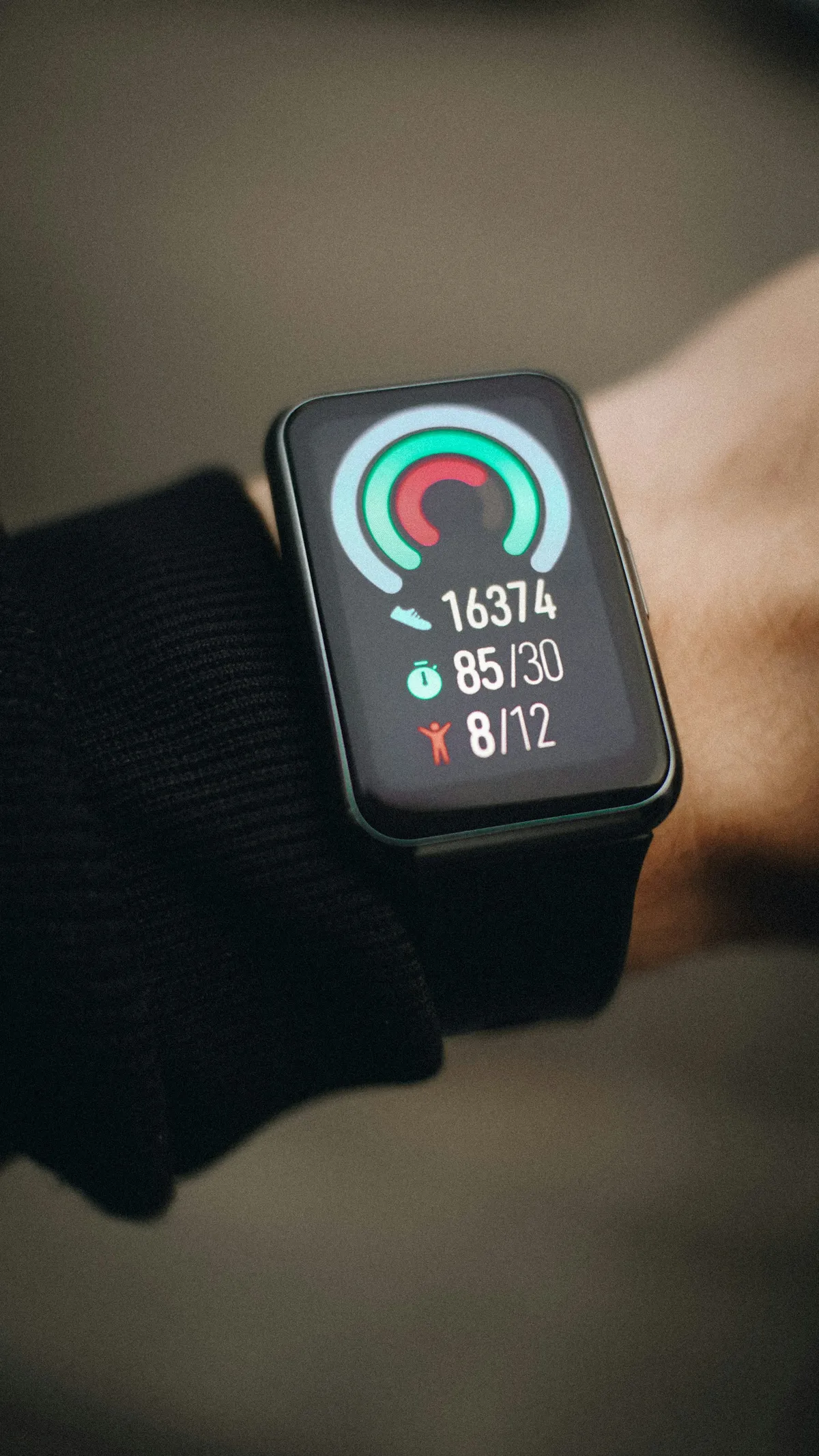
Why Your Smartwatch Says You Burned 600 Calories and You Still Didn't Lose Weight
Your watch said you burned 612 calories during that session. You ate conservatively all week. The scale didn't move. If you've lived this exact Tuesday, the problem isn't your effort — it's the number on your wrist. It was never built to be accurate for you specifically. It was built to be accurate on average, across a population you don't belong to.
What Your Watch Is Actually Measuring
Your wearable doesn't measure calories. It measures heart rate, motion, and sometimes skin temperature, then runs those signals through a formula calibrated on a generic dataset — typically a mix of ages, body compositions, and fitness levels that may not resemble you at all. A 46-year-old executive carrying more muscle than the average test subject, recovering from a shoulder issue, training at a lower heart-rate zone on purpose, will get an estimate that's systematically off. Not randomly off — systematically. Research on consumer wearables has repeatedly found calorie-burn errors in the 20-40% range, and the error isn't consistent in one direction, which makes it useless for the kind of precision you're trying to apply to a 500-calorie daily deficit.
Here's the part that matters more: even if the exercise number were perfect, it's a small slice of the real equation.
The Three Numbers Getting Mixed Together
Total daily energy expenditure is three things stacked on top of each other, and your watch is only built to guess at one of them.
- Basal metabolic rate — what your body burns at rest, driven by muscle mass, age, and hormones. This is 60-70% of your daily total, and your watch doesn't measure it directly; it estimates it from your profile data, which goes stale the moment your body composition changes.
- Non-exercise activity — walking to meetings, standing in airports, the fidgeting and pacing that happens during a stressful call. This is bigger than most people assume, and it's also the number your watch tracks least reliably, because it's low-intensity and easy to misread as "not moving."
- The workout itself — the number that lights up green on your screen and feels like the whole story. It's usually the smallest of the three.
You are not the problem for trusting the number your device hands you. Your current system is the problem — one built around a single, shaky estimate instead of the two bigger, steadier ones underneath it.
Why the Error Compounds Over a Week
A single day's overestimate is a rounding error. A week of "the watch said I had room for a bigger dinner" compounds into a real number. If your device runs 25% hot on a 500-calorie training session four times a week, that's roughly 500 phantom calories you've mentally spent that your body never actually burned. Multiply that by a month of travel, client dinners, and a packed calendar, and you've built an entire eating pattern on a number that was wrong from the first day. This is exactly the kind of slow, invisible drift that turns "I'm doing everything right" into a plateau nobody can explain — until someone looks at the math instead of the mirror.
What Actually Predicts Whether the Scale Moves
The fix isn't a better watch. It's not tracking harder. It's building around numbers you can actually verify, instead of a device-generated guess. That's the whole logic behind protein floors and calorie ceilings instead of a rigid meal plan: a minimum protein target that protects muscle no matter what the day looks like, and a calorie ceiling built from your real intake history and real-world progress — not from a wrist sensor's assumption about a stranger's metabolism.
It also means watching trends, not single numbers. Scale weight, waist measurement, how clothes fit, and energy levels over two to three weeks tell you far more than any single workout's calorie count. A coach adjusts the ceiling based on what's actually happening to your body over time, then recalibrates — the same way you'd trust a quarterly trend over one noisy data point in a business dashboard.
The System, Not the Sensor
None of this means ditch the watch. Heart-rate trends and step counts are still useful signals for effort and recovery. The mistake is treating the calorie-burn figure as a precise input you can bank on for a deficit that's supposed to be accurate to the hundred. It isn't, and it was never going to be, for a 45-year-old business owner with a full calendar and a body that doesn't match the device's generic model.
This is the same pattern behind almost every stalled plan we see: a busy, capable person doing real work, undone by a system that wasn't built for their actual week. Over 1,200 clients and 10,000+ pounds lost later, the pattern holds — the people who get results aren't the ones with the fanciest tracker. They're the ones with a system that adjusts to real data, real travel, and real life, instead of asking them to out-discipline a bad number.
If your results have stalled and you suspect the tracking, not the training, is the issue, apply for a discovery call and we'll build a system around numbers you can actually trust: Apply Now.